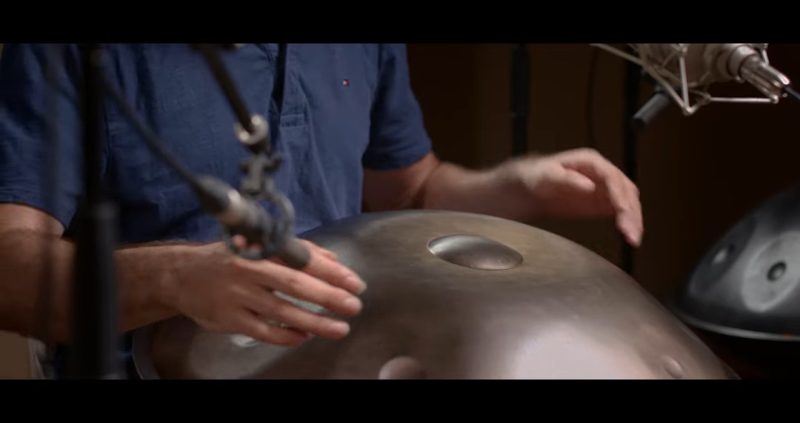
In this episode of Behind Immersed, we dive into the creation of “River’s Edge,” the fifth track on the record—a piece born from a simple, meditative idea and expanded into a richly layered immersive experience in Dolby Atmos.
The journey begins with Himalayan singing bowls, building a minimalist texture through interlocking patterns—small, repeating cells that slowly layer on top of one another. Drawing deeply from Indian classical music, the composition is melodically rooted in Raga Jog, a beautifully light, film-friendly raga in the key of B. We explore its characteristic motion between flat and major thirds, and how that melodic shape becomes the backbone of the main theme.
Harmonically, the piece moves between B7 and B minor, while the bassline and groove evolve underneath. Tabla virtuoso Ed Hanley establishes a Dadra-based feel—a three- or six-beat pulse—while drummer Derek carefully avoids slipping into a shuffle, instead locking in a subtle backbeat that supports the minimalist build.
As the piece unfolds, it behaves very much like a minimalist composition: new layers enter gradually over time. Horns and strings swell around the listener, moving between B major and B minor triads. In the immersive mix, the original singing bowl patterns are translated into tabla figures orchestrated all around the listener, each simple loop occupying its own spatial pocket.
Melodies on sarod and sarangi—performed by Aditya Verma and Pankaj Mishra—weave through the texture, intertwining and improvising over the raga framework. Co-producer Drew Jurecka plays a crucial role in shaping the final arrangement, constantly stripping back excess layers to create space so that the primary melody rises clearly to the surface instead of being overwhelmed by the density of parts.
From an immersive audio perspective, “River’s Edge” embodies why minimalist music feels so at home in Dolby Atmos. Rather than squeezing a complex web of loops into two speakers, the piece places the listener inside the ensemble, much like sitting in the middle of a gamelan orchestra—surrounded by metallic timbres and circular patterns that build a single, evolving sonic experience.
The arc of the piece carries the listener upward through accumulation and interplay, then gently releases back down: returning to the singing bowls, and finally dissolving into a simple drone. From there, the music takes on a new color with the introduction of hang drum, performed by Cinnaba Die, who brings in a metallic, pitched-percussion voice tuned specifically to fit the piece’s scale. His improvisation leads seamlessly into a B-pentatonic-flavored groove, joining the broader percussion ensemble of tabla, udu, duff, shakers, and drums.
In the end, “River’s Edge” is a study in simplicity made expansive: many individually simple parts, each given room to breathe in three-dimensional space, gradually merging into a single, unified musical river that carries the listener from first note to final release.


Justin Gray is an award-winning mix engineer, mastering engineer and producer based in Toronto, Canada. He works with artists from around the world in a wide range of musical styles, in his world-class facility equipped for stereo and immersive audio music production.
Don't miss a beat
Sign up to receive Justin Gray Sound’s email newsletter — featuring the latest educational videos, product reviews, and all things immersive audio.